
The short answer: use several clues, not one
To tell offset lithography from other stamp printing methods, look for a pattern of evidence rather than a single visual trick. The American Philatelic Society identifies four major families used for postage stamps: line-engraved intaglio, gravure, letterpress, and lithography. That means a safe identification starts by asking which family best fits the stamp overall, then checking whether more than one process may be present.
Offset lithography is a planographic process, so the image is formed on a smooth surface rather than cut or etched into a plate. In practical collector work, this means you should compare the stamp under non-contact magnification and different lighting, then match what you see against known printing records when available. StampSnap can help you keep a likely identification record, but the visual match still needs collector judgment.
What offset lithography is, in plain collector language
The Smithsonian National Postal Museum explains offset lithography as a planographic process in which oil-based ink adheres to the image area and a rubber blanket transfers, or offsets, that image to paper. Modern stamp lithography commonly combines separate process-colour layers made from very fine dots. Because of that, a stamp may show a dot structure, but the dot pattern itself is not enough to prove lithography.
The museum also notes that modern lithography can be sharp, so soft or blurred edges are not a dependable identifying rule. That matters because collectors sometimes expect lithography to look obviously fuzzy, which is not always true. The safest approach is to treat edge quality, dot structure, and overall print character as cumulative clues that need support from other evidence.
How to separate lithography from intaglio, gravure, and letterpress
The clearest first contrast is with line-engraved intaglio. The APS says line-engraved intaglio transfers ink from deliberately incised lines, and its design is normally constructed from lines, hatching, cross-hatching, and stippling. Under magnification and oblique light, raised ink can sometimes be seen, and pressure may leave debossing on the reverse. Those features point away from lithography, which does not rely on incised lines in the same way.
Gravure is also a recess process, but it forms tone from screened cells rather than from the line structure typical of line-engraved intaglio. The APS cautions that screened or raised effects can appear in other processes too, so collectors should not use a single dot or cell pattern as proof. Letterpress belongs to the four major families identified by APS, but the important practical lesson is the same: compare the whole stamp, because modern issues may combine more than one process.
A safe viewing routine that avoids false certainty
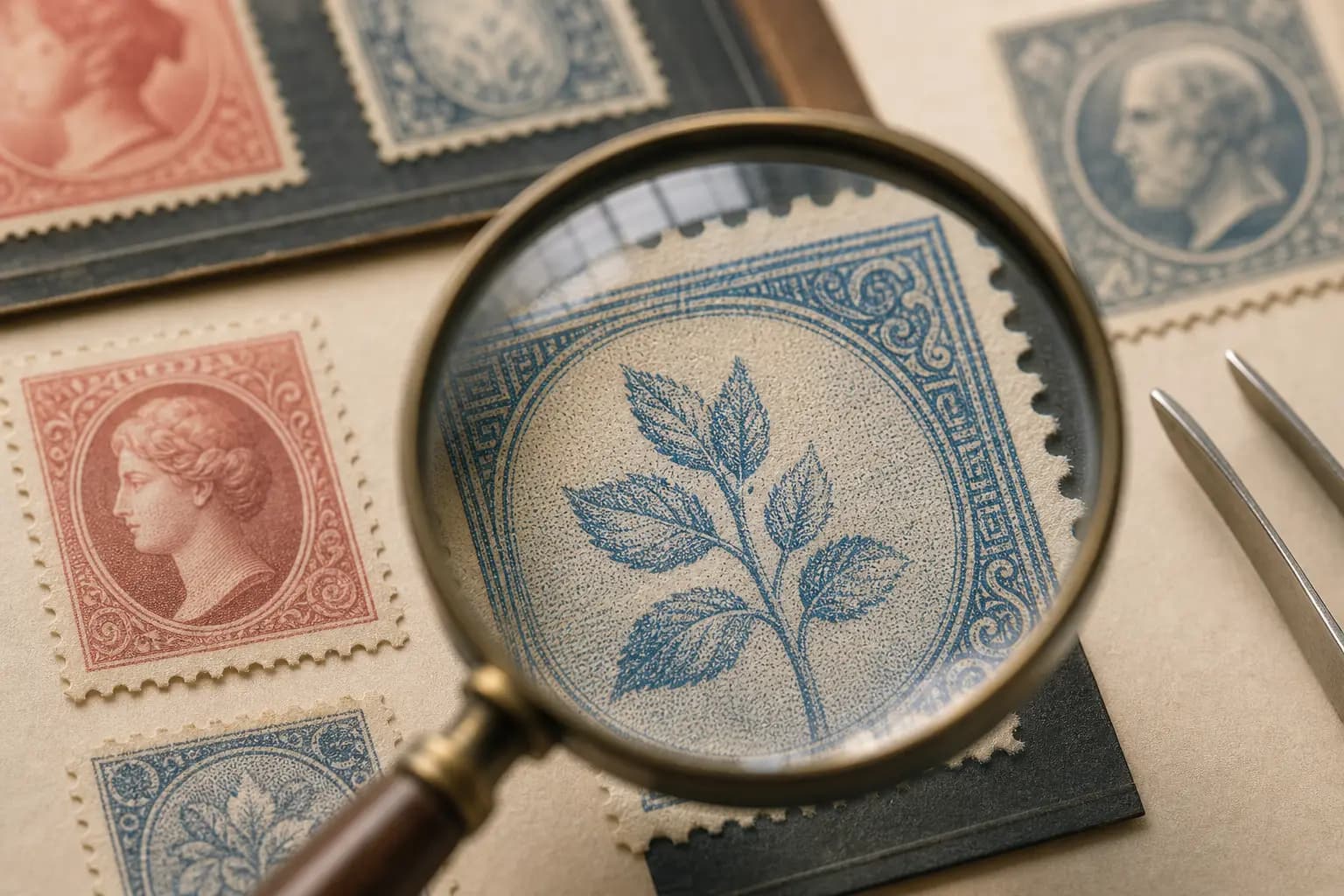
Use only non-contact magnification, diffuse light, and oblique light. Start with the whole design, then inspect small areas for the texture of printed lines, the presence of screened dots, and whether the image seems built from separate layers. Do not press, rub, or soak a stamp just to test its printing method. If the stamp is on a cover or appears fragile, leave it in place and work only from what you can see safely.
Remember that two features can mislead at once. A lithographed stamp may look sharp, and a gravure stamp may show screened structures under magnification. Softness, blur, or dot patterns alone are therefore unreliable. The most careful collector uses repeated observation from different angles, compares similar stamps side by side, and then consults production records before making a final note.
Why modern stamps can be especially confusing
The APS states that more than one process may appear on a modern stamp. That means a single issue can combine printing families or use separate methods for different parts of the design. A stamp may therefore show lithographic colour layers alongside another process, which is why one clue should never override the rest of the evidence.
Modern lithography often uses very fine dots, and those dots may be visible only under magnification. But similar screened structures can also appear in gravure and other processes. If you are building a reference collection or trying to organise an uncertain group, keep notes on what you actually observed: line structure, dot pattern, pressure marks, edge character, and any production information you can verify later.
A methodical checklist for collectors
First, identify the family you are most likely seeing: line-engraved intaglio, gravure, letterpress, or lithography. Second, look for supporting features under magnification and oblique light, such as line construction, screened dots, or signs of pressure. Third, decide whether the stamp seems to be a single-process issue or part of a modern combination. Fourth, check reliable production records when they are available.
If your conclusion is still uncertain, record the stamp as provisional rather than forcing a final answer. That is especially useful when you are sorting a mix of used and mint material, or when the image is small, worn, or partly obscured. A careful note today is better than an overconfident label that must be corrected later.
What not to do while identifying print method
Do not rely on one shortcut such as dot pattern alone, soft edges alone, or the presence of visible texture alone. The supplied sources specifically warn that screened or raised effects can appear in more than one process, and that blurred or soft edges are not dependable on modern lithography. A sound identification comes from combining observations, not from forcing one feature to do all the work.
Do not use harsh handling or wet treatment as an identification test. Safe identification is a visual and documentary process. If you are cataloguing stamps for a collection record, keep the stamp flat, handle it with suitable tools, and preserve the evidence you already have. That is the most reliable way to protect both the stamp and your notes.
Frequently asked questions
Can I identify offset lithography from dots alone?
No. Fine dots may appear on modern lithography, but dot patterns can also appear in gravure and other processes, so they must be combined with other clues.
Is a soft or blurred design proof of lithography?
No. The Smithsonian National Postal Museum notes that modern lithography can be sharp, so softness or blur is not a dependable rule.
What features point toward line-engraved intaglio instead?
Line-engraved intaglio is built from deliberately incised lines, often with hatching, cross-hatching, and stippling, and may show raised ink or reverse debossing under suitable light.
Why do modern stamps cause identification problems?
Because more than one process may appear on a modern stamp, and separate layers or techniques can create mixed visual clues.
Should I soak a stamp to inspect the printing method?
No. The safe approach is non-contact viewing with magnification and light, plus production records when available.