
Introduction to Planographic Identification
Postage stamps are produced using several distinct printing technologies, each leaving unique physical signatures on the paper. Among these, offset lithography stands out as a highly efficient, modern method. To correctly identify this process, collectors must look beyond simple visual shortcuts. Instead of relying on a single feature, a safe and methodical examination of planographic ink transfer, surface texture, and cumulative clues is necessary.
By understanding how ink behaves when transferred from a flat surface, you can distinguish offset lithography from other major printing families. This guide outlines the physical characteristics of lithographic stamps and teaches you how to analyze them safely without risking physical damage to your collection.
The Planographic Principle and Ink Transfer
According to the Smithsonian National Postal Museum, offset lithography is a planographic process. This means the image is formed on a completely smooth surface rather than being cut, etched, or raised on a plate. The process relies on chemical principles where oil-based ink adheres to the designated image area on the smooth plate, while non-image areas repel it.
Because the printing plate is flat, the ink layer transferred to the stamp is exceptionally thin and uniform. Unlike recess methods where ink is held in deep grooves, planographic printing does not deposit heavy, raised ridges of ink onto the paper. This flat ink profile is one of the primary clues collectors look for during examination.
The Role of the Rubber Blanket in Offset Transfers
The term "offset" refers to the mechanical transfer of the design. Rather than printing directly from the plate to the paper, the oil-based ink is first transferred, or offset, to an intermediate rubber blanket. This flexible rubber blanket then presses the ink onto the stamp paper.
This intermediate step ensures a smooth, even application of ink across the paper's surface. Because there is no heavy metal plate pressing directly into the paper fibers, offset lithography does not produce physical debossing on the reverse or highly raised ink on the obverse. This lack of physical indentation helps distinguish it from classic recess methods.
Analyzing Process-Color Layers and Dot Structures
Modern stamp lithography commonly combines separate process-color layers made from very fine dots. When examining a stamp under non-contact magnification, these dots can easily be mistaken for other printing styles. The Smithsonian National Postal Museum notes that a dot pattern must always be interpreted alongside other evidence.
This caution is necessary because gravure—which is a recess printing process—and other methods can also show screened structures under magnification. Relying solely on the presence of dots to diagnose lithography can lead to misidentification. Collectors should always combine their visual observations with official production records to confirm the printing method.
Why Edge Sharpness Can Be Deceptive
A common misconception among some collectors is that lithographic prints always feature soft or blurred edges. However, the Smithsonian National Postal Museum highlights that modern lithography can be incredibly sharp. Consequently, soft or blurred edges are not a dependable identifying rule.
To build a reliable identification, you must combine your visual observations with official production records and catalog details. Digital tools like StampSnap can help you log these observations and keep a structured record of your collection's printing varieties as you build your database.
Comparing Lithography to the Other Major Families
To isolate offset lithography, it helps to understand the other three major printing families identified by the American Philatelic Society: line-engraved intaglio, gravure, and letterpress. Line-engraved intaglio transfers ink from deliberately incised lines, creating designs constructed from lines, hatching, cross-hatching, and stippling. Under magnification and oblique light, intaglio stamps may show raised ink on the front and debossing on the reverse.
Gravure, while also a recess process, forms its tones from screened cells. Letterpress, a relief process, transfers ink from raised surfaces. By ruling out these distinct physical characteristics, you can narrow down your stamp's printing family. Remember that more than one process may appear on a modern stamp, making a methodical approach essential.
Safe Examination Workflows for Collectors
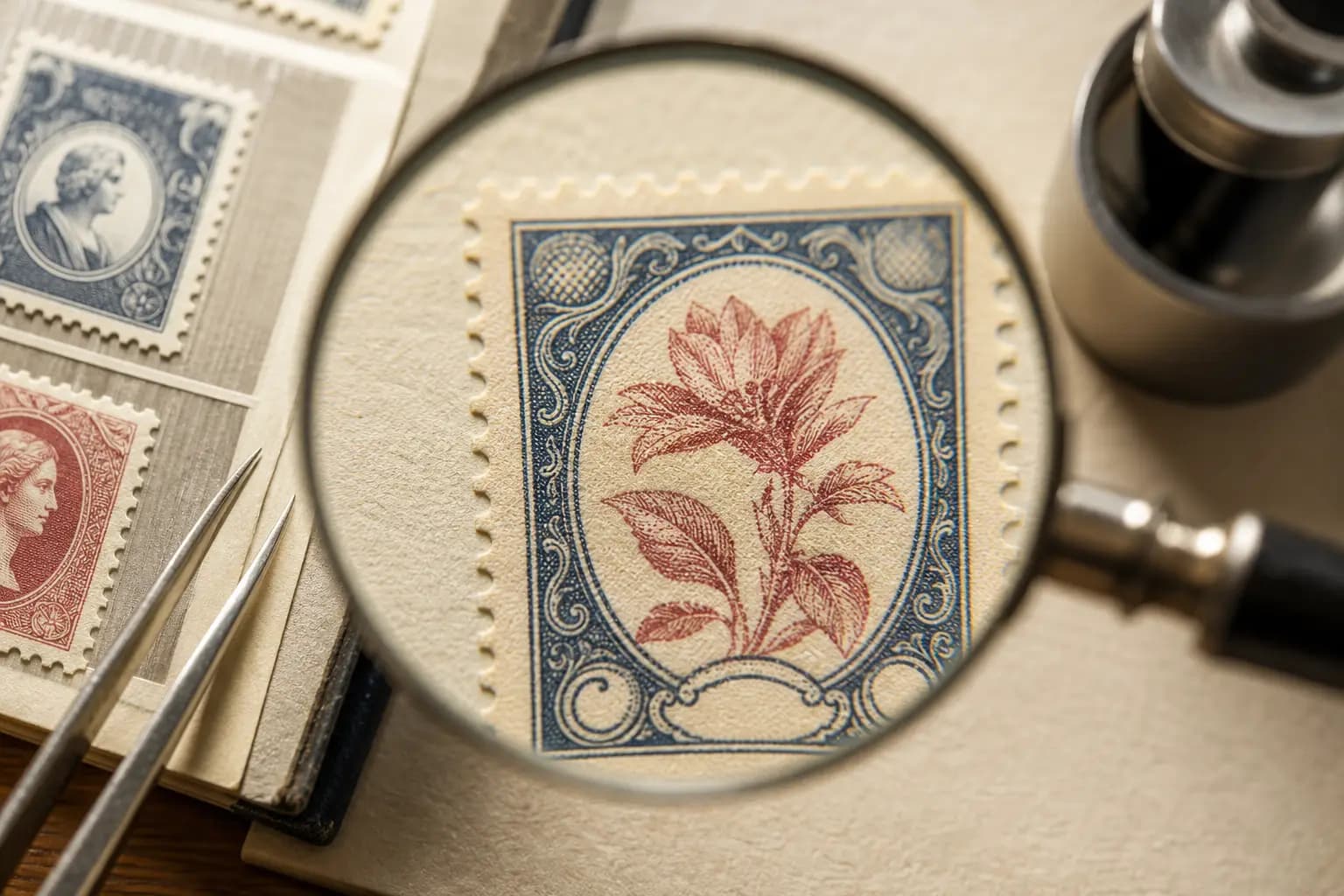
When analyzing a stamp's printing method, preservation must always come first. Never touch the surface of a stamp with your fingers or slide heavy tools across its face. Instead, use non-contact magnification, such as a high-quality loupe, combined with diffuse or oblique light to study the ink structure.
Oblique light—shined at a shallow angle across the stamp—is particularly useful for confirming the flat, uniform profile of offset lithography versus the raised texture of intaglio. Once you have gathered your cumulative clues, you can use StampSnap to document your findings and compare them with known production records to build a highly accurate personal catalog.
Frequently asked questions
How does offset lithography differ from line-engraved intaglio?
Offset lithography is a planographic process where oil-based ink is transferred from a smooth surface via a rubber blanket, resulting in a flat ink profile. Line-engraved intaglio is a recess process where ink is transferred from incised lines, often leaving raised ink on the front and debossing on the back.
Can I identify offset lithography just by looking for dots?
No. While modern lithography uses process-color layers made of fine dots, gravure and other processes also display screened structures under magnification. You must combine multiple visual clues and consult production records for an accurate identification.
Are soft or blurred edges a reliable sign of lithography?
No. The Smithsonian National Postal Museum notes that modern lithography can be very sharp, meaning soft or blurred edges are not a dependable identifying rule.
What tools should I use to safely inspect a stamp's printing method?
Use non-contact magnification, such as a magnifying glass or loupe, along with diffuse or oblique light. Oblique light helps reveal whether the ink is raised (like intaglio) or flat (like lithography) without physically touching the stamp.