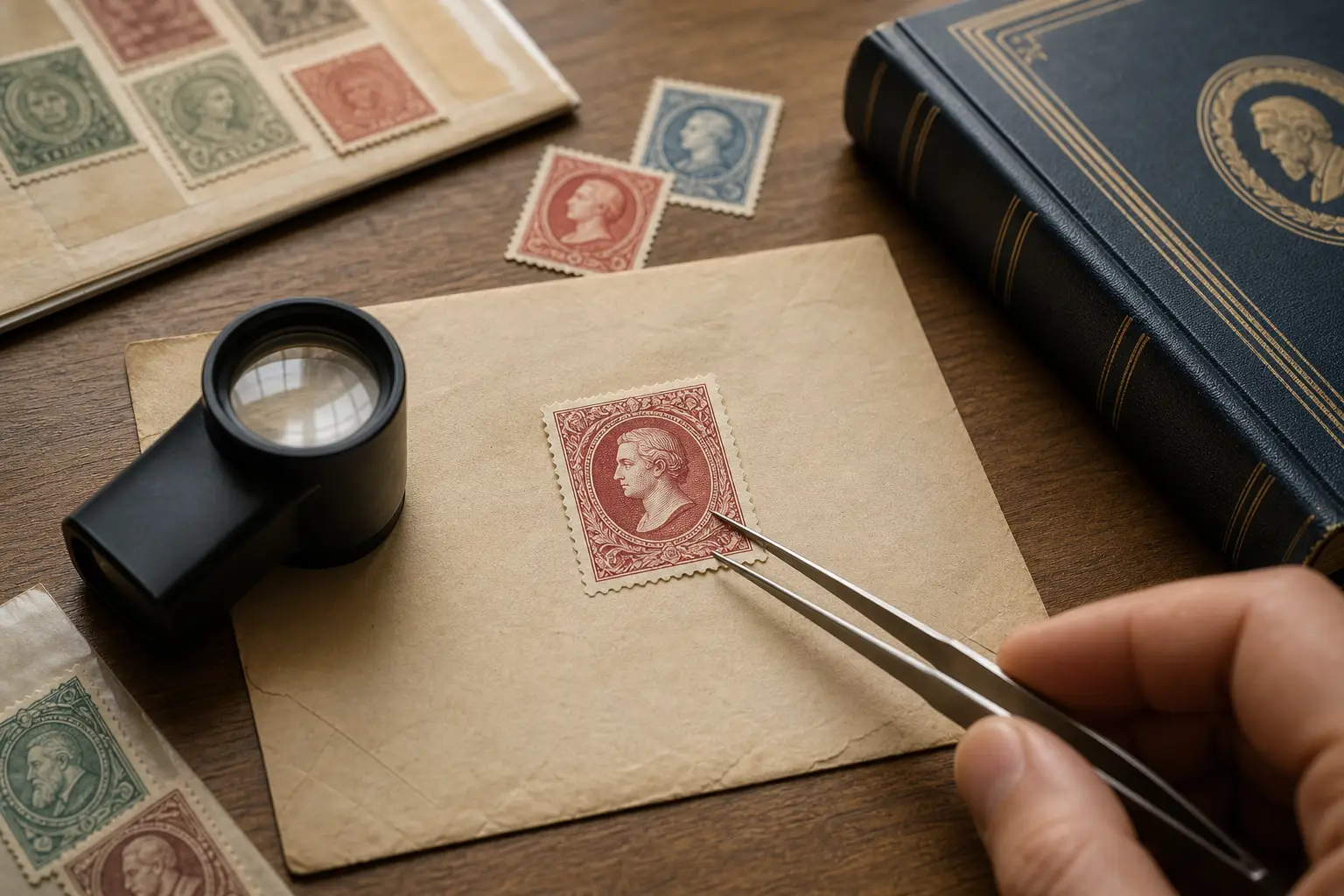

The short answer: yes, a watermark can change value a lot
Yes. A watermark can be the only difference between two stamps that look the same but are listed as different catalog issues, and that difference can move a stamp from common to significantly more valuable. The American Philatelic Society notes that stamps with the same design may differ by the presence or absence of a watermark, or by the watermark design itself, and those differences generally receive separate catalog numbers.
That is why a watermark matters in valuation. It is not just a paper curiosity. It may be the feature that tells you whether you have one version of a stamp or another. If you are trying to work out value, you should treat watermark checking as a standard part of identification, not as an optional extra.
Why a watermark can create a different catalog issue
Watermarks are a security measure built into stamp paper to deter counterfeiting. They may appear as words, letters, symbols, or monograms, and they are formed by dies attached to the paper-making frame. Because the watermark is part of the paper itself, it can define a distinct version of the stamp even when the printed design looks unchanged.
The key valuation point is simple: some stamps exist on both unwatermarked and watermarked paper, and some exist on paper with different watermarks. When that happens, the catalog may treat them as separate issues. APS explains that the watermark may be the sole difference between a very common stamp and a stamp valued much higher. That is why a careful watermark check can change your first estimate of what the stamp is worth.
How to check a watermark without risking damage
Start with the least risky method. Some watermarks can be seen by holding the paper up to light, especially if the mark is bold or the stamp is from a country where watermarks are easier to observe. But many stamps need closer study, and guessing from memory or from a blurry photo is not reliable enough for valuation work.
APS recommends laying the stamp face down in a dark tray and moistening it with watermark fluid so the watermark appears in dark lines against a lighter background. The source notes that watermark fluid evaporates quickly and should not affect the gum on an unused stamp, and that commercial watermark fluid is preferred over lighter fluid. The same source says APS helped develop and uses Clarity watermarking fluid, and it also mentions watermark detectors such as the Safe Signoscope and Morley Bright Watermark Detector.
Why lighting, angle, and partial marks can mislead you
A watermark is often not fully visible. APS notes that many stamps show only a portion of the watermark, sometimes just part of a single letter. That means a partial impression can still be meaningful, but it also means that incomplete visibility can cause mistakes if you stop too early or compare against the wrong reference.
This is especially important with U.S. material, where the source says the double line USPS watermark was used on postage stamps from 1895 to 1910 and the single line USPS watermark from 1910 to 1916. The same source also says some U.S. watermarks are particularly difficult to see. In practice, that means a faint trace is not enough on its own; you need to compare the mark, the design, and the issue period carefully before drawing a value conclusion.
Use design clues together with the watermark
Watermarks should never be checked in isolation. APS’s guidance on attention to detail shows why: look-alike stamps can have nearly identical designs, but small differences in the printed details, watermark, and perforations determine the true identity. The article gives examples where apparently similar stamps belong to different catalog numbers because of specific wording or design details.
That same approach applies to valuation. A watermark may confirm that you are looking at a different issue, but the final identification should still be cross-checked against other visible features. If the stamp is part of a set with similar designs, compare the inscription, corner details, color, and perforations before you record it as a higher- or lower-value version.
How to record what you found before you price it
Once you believe you have found the watermark, record exactly what you observed: whether it was visible by light, fluid, or a detector, whether it appeared complete or partial, and any matching design clues. This creates a safer basis for later comparison with a catalog or specialist reference. If you use StampSnap to create a likely identification or collection record, keep the watermark note attached to that record so you can review it later.
Do not rush to assign a value from the watermark alone. The source evidence shows that watermark differences can separate catalog numbers, but it also shows that some marks are hard to see and easy to misread. A careful note of the observation is often more useful than a quick conclusion, especially when the stamp is unused, fragile, or difficult to compare cleanly.
When uncertainty means you should pause
If the watermark is only partly visible, if the paper has a complex design, or if you cannot match the mark confidently to a known issue, the safest answer is to leave the valuation as provisional. That is not a failure; it is responsible collecting. The evidence provided by APS makes clear that some stamps require more sophisticated study, and that a small piece of the watermark may be all you can see at first.
A conservative approach protects both the stamp and your records. Check gently, note uncertainty, and avoid assumptions based on a single trait. In valuation work, a carefully documented watermark is more useful than a confident but unsupported claim.
Frequently asked questions
Do watermarks always make a stamp more valuable?
No. The source evidence says watermarks can separate one catalog issue from another and may be the only difference between a common stamp and a much more valuable one, but the value effect depends on the specific stamp and watermark.
What is the safest way to check a watermark?
APS recommends placing the stamp face down in a dark tray and using watermark fluid, which evaporates quickly and should not affect the gum on an unused stamp. Commercial watermark fluid is preferred.
Can I identify a watermark just by looking at the front of the stamp?
Sometimes, but not reliably. Some watermarks can be seen by holding the paper to light, while many require closer study or watermark fluid. Partial marks can also be difficult to interpret.
Should I value a stamp from the watermark alone?
No. Watermark differences are important, but APS also stresses careful comparison of design details, perforations, and other clues. Use the watermark as one part of the identification, not the only part.