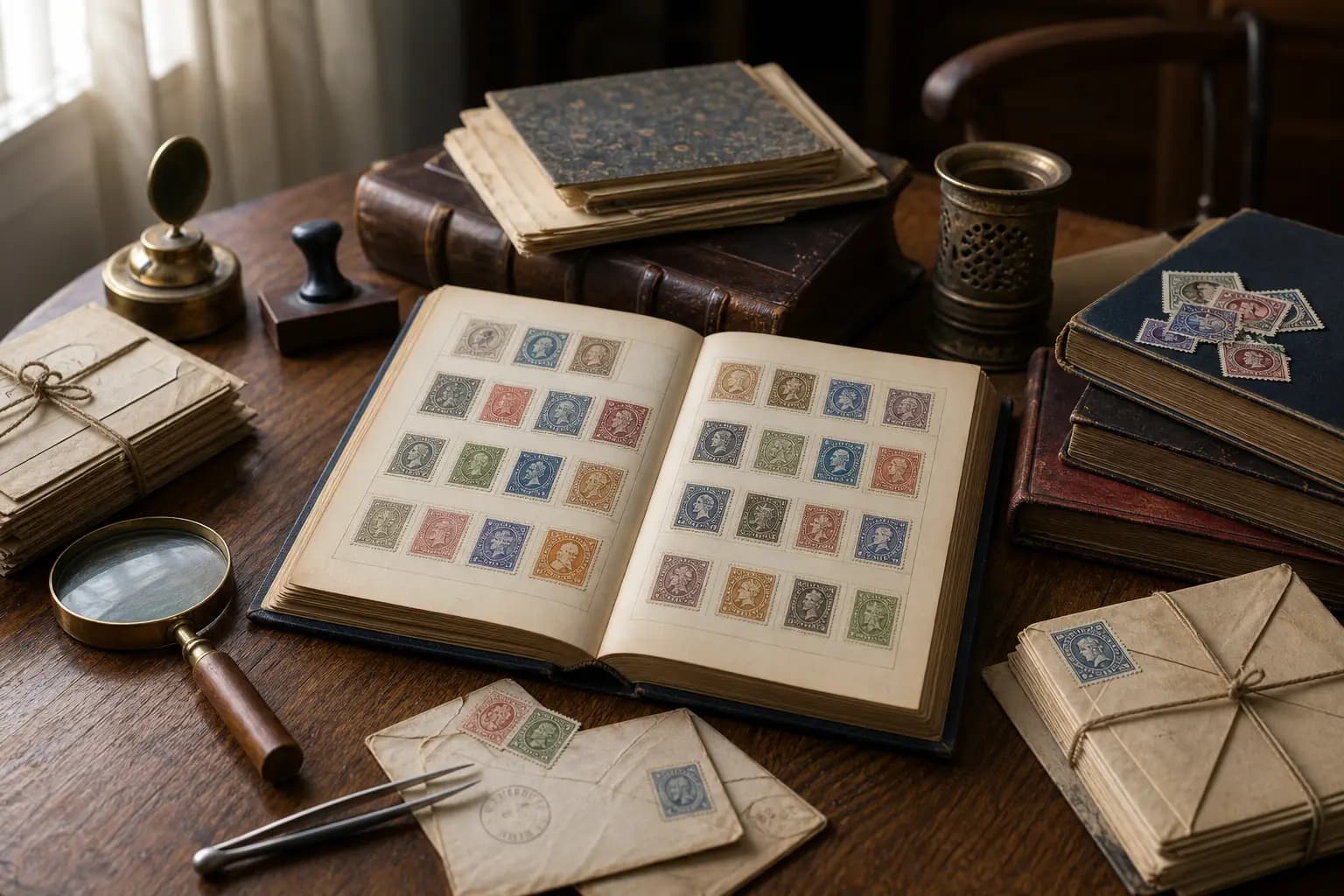
The short answer: stamp clubs turned private collecting into shared reference work
Stamp clubs created reference material and shared knowledge by giving collectors a place to compare stamps, discuss what they found, exchange material, and record results. The Smithsonian National Postal Museum describes organized philately as growing out of collectors gathering to compare, discuss, and exchange stamps, with local clubs and societies forming around countries, periods, or subjects. In that setting, clubs became useful not only for social contact but also for education, research, and exhibiting.
That history matters because many collecting questions are easiest to solve when one collector’s observations are tested against another’s. Clubs did not make every answer universal, and they did not eliminate the need for careful checking. But they did create a practical framework where members could learn from one another, preserve notes, and build reference habits that outlasted a single meeting.
Why collectors formed clubs in the first place
The American Philatelic Society’s history shows that stamp collecting expanded steadily from a small group of enthusiasts in the 1850s. By the 1880s, the hobby had grown enough in the United States that the APS records an estimated 25,000 collectors. In 1886, several prominent collectors began discussing a national organization, and by April they had formed The Committee on National Organization and issued an announcement about the possible creation of such a body.
That same year, the effort gathered wide support: some 400 collectors said they were willing to help found the organization, and 219 sent proxies to vote. On September 13, 1886, a committee in New York City adopted the name American Philatelic Association. The date gives a useful milestone for collectors because it shows how quickly informal enthusiasm can become a structured source of records, services, and standards when enough people share the same need.
What club services helped turn interest into usable information
The APS history page lists several early services that helped members learn and compare material. Annual conventions began with the first meeting on September 13, 1886 and continued yearly. The Purchasing Department helped members procure new issues or obsolete stamps at or near face value. The Exchange Department was intended to facilitate the exchange of duplicate stamps, entire envelopes, and postal cards among members through exchange books and boxes. Those services made collecting more orderly and more collaborative.
The same history also shows a Library Department and a counterfeit detector. The library depended in part on donations in its early stage, but its presence shows that clubs understood the value of keeping information together. The counterfeit detector role, filled by E. A. Holton in the early days of the APA, responded to the problem of fraudulent stamps. For collectors, that is an important lesson: club knowledge was not just social; it also helped protect members from errors and bad material.
How journals and libraries preserved what members learned
According to the APS history, the first five issues of The American Philatelist were published in Altoona, Pennsylvania, beginning January 10, 1887. A journal gives collectors something a meeting cannot: a record that can be reread, compared, and kept for later study. Once observations are printed, they can be shared beyond the room where they were first discussed. That is one reason club publishing became so important to philatelic history.
The APS club resources page also points to books and guides on club work, including material on running meetings, producing a newsletter, developing a speakers’ program, and editing stamp club journals. The Smithsonian likewise notes that societies published research and created reference material. Taken together, these sources show a practical pattern: clubs did not merely talk about stamps; they documented their work so members could use it again, verify details, and build better habits over time.
How exhibitions and study groups deepened specialist knowledge
The Smithsonian National Postal Museum says that exhibitions gave participants a structured way to present collections, learn from other displays, and compete for recognition. That matters for research because an exhibition forces the collector to make choices about order, identification, and evidence. A display can reveal gaps, invite corrections, and encourage better descriptions. It is a disciplined format, not just a showcase.
The museum also explains that local clubs and societies often formed around particular countries, periods, or subjects. That specialization made knowledge more focused. A collector interested in one area could find others with similar interests, and the group could develop more precise notes and reference material. If you are building a personal record today, a tool such as StampSnap can help create a likely identification note or collection record, but it should be treated as a working aid rather than final proof.
What collectors can safely borrow from club history today
The safest lesson from club history is to work methodically. Compare stamps against multiple references when possible, keep notes on what you observed, and record uncertainty instead of forcing a conclusion too early. If a stamp is damp, fragile, or still attached to postal material, handle it carefully and avoid aggressive cleaning or unnecessary separation. Club history shows that shared knowledge is most useful when it is recorded accurately and handled responsibly.
You can also copy the old club habit of asking better questions before deciding on an answer. Is the item part of a larger cover or postal card? Does it belong to a known issue, a local study group, or a specialist topic? Would another collector or exhibit page help confirm the detail you think you see? These habits reflect the same educational purpose described by the APS and the Smithsonian: collect, compare, document, and learn from the results.
Why this history still matters to modern collectors
The history of stamp clubs is not only about social meetings. It is about how collectors built systems for learning: journals, libraries, exchanges, conventions, and exhibits. The APS records the rapid growth from a few enthusiasts in the 1850s to an organized association in 1886, while the Smithsonian describes clubs as places for exchange, education, research, and exhibiting. Together, those accounts explain why club history remains relevant to anyone trying to identify, organize, or study stamps with care.
For a modern collector, the main value is not nostalgia. It is the method. When collectors share evidence, write it down, and keep it accessible, the hobby becomes easier to study and less dependent on memory alone. That is the lasting contribution of stamp clubs to philatelic knowledge: they helped turn individual interest into a practical record that others could use later.
Frequently asked questions
Did stamp clubs only serve as social groups?
No. The Smithsonian says clubs also supported education, research, and exhibiting, and the APS history shows services such as exchanges, a library, conventions, and a counterfeit detector.
When did organized philately begin to take shape in the United States?
The APS history says collecting grew from the 1850s, and by April 1886 collectors had formed a committee for national organization. The American Philatelic Association was adopted on September 13, 1886.
Why were club journals important?
Journals preserved research and observations in a form that could be reread and shared later. The APS history says The American Philatelist began publication in 1887.
Can a club replace expert checking of a stamp?
No. Clubs can help collectors compare evidence and learn from others, but the sources here do not say they provide official authentication. They are best used for study, reference, and discussion.