The short answer: use several safe clues, not one test
The safest way to check a stamp’s printing family is to compare several visible clues and then stop short of a final conclusion unless the evidence agrees. The American Philatelic Society identifies four major families used for postage stamps: line-engraved intaglio, gravure, letterpress, and lithography. Because more than one process may appear on a modern stamp, and because some visual effects overlap, no single feature should be treated as proof on its own.
A practical collector workflow is simple: look first at the overall design, then study the line structure, ink appearance, and paper under non-contact magnification and diffuse or oblique light. Use those observations to narrow possibilities, not to force a match. If the stamp is important, compare what you see with production records or trusted reference material before you record it in a collection log or in StampSnap as a likely identification.
Start with the line structure and how the design is built
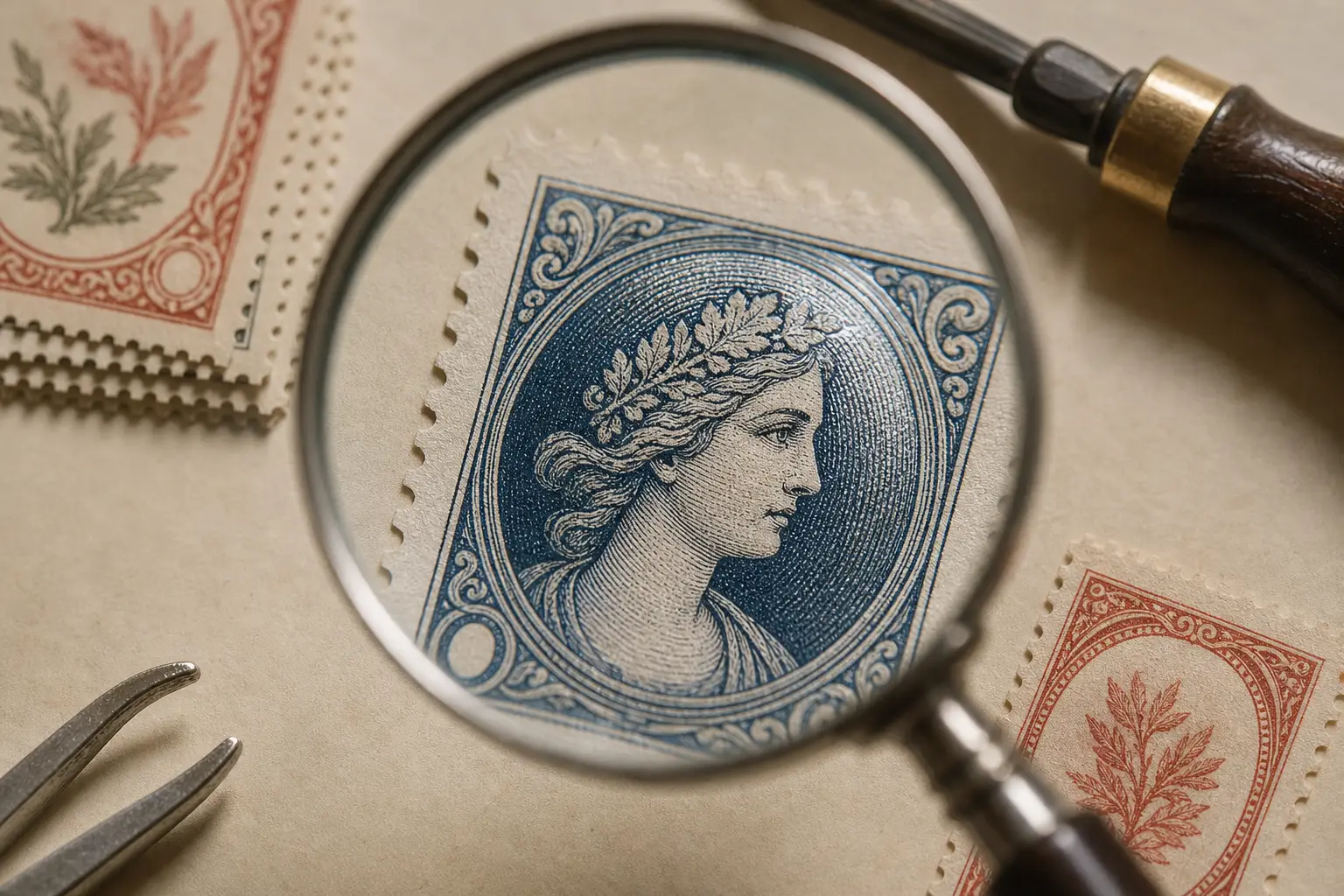
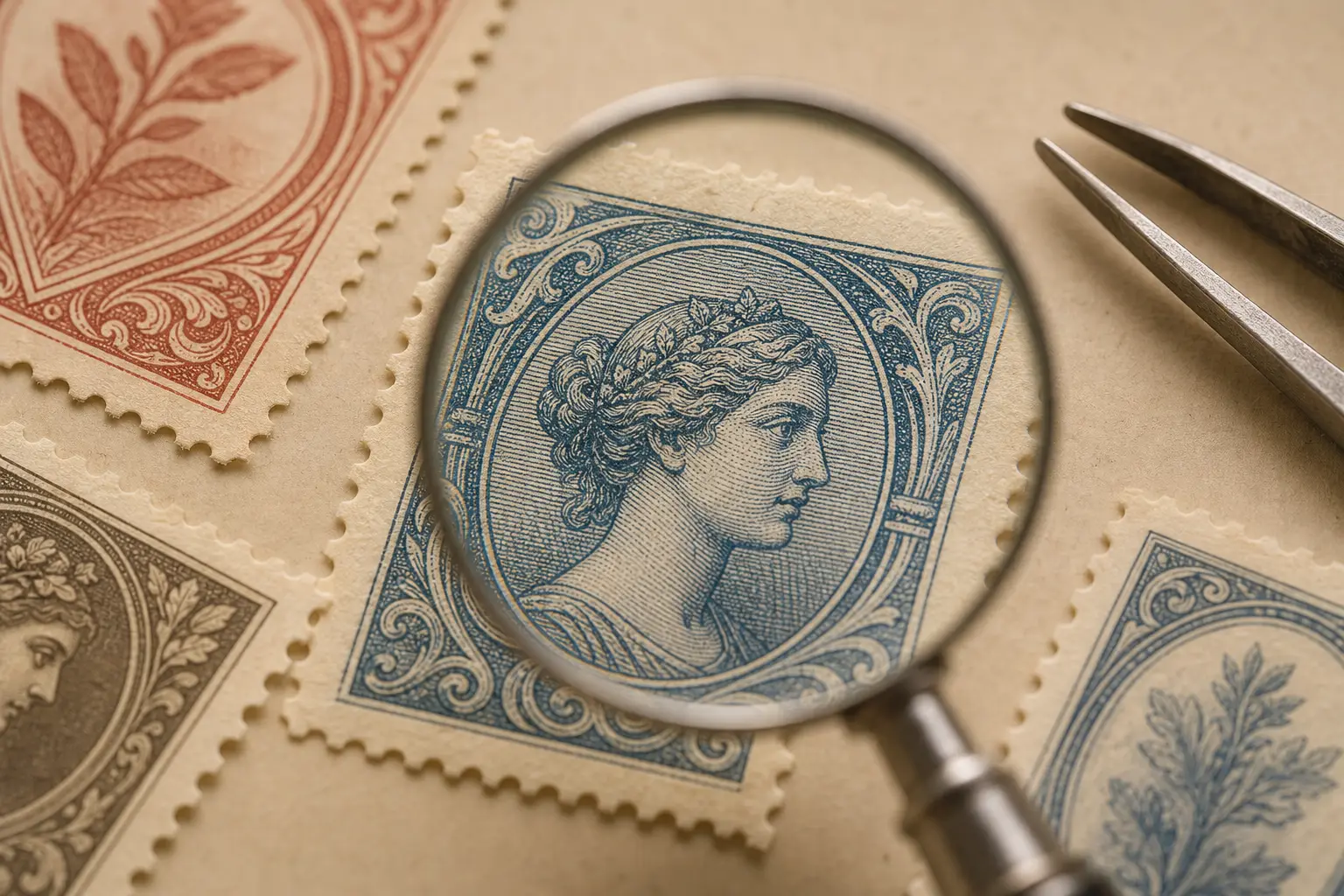
Line-engraved intaglio is built from deliberately incised lines. Its design is normally constructed from lines, hatching, cross-hatching, and stippling. Under magnification, that structure often looks like it was drawn from many tiny marks rather than laid down as a flat field. The APS notes that raised ink can sometimes be seen under magnification and oblique light, and that pressure may leave debossing on the reverse.
Those features are useful, but they are supporting clues rather than a single test. A stamp may show some surface texture without being line-engraved intaglio, and a strong printed impression can be misleading if you examine only one small area. The safest method is to compare multiple parts of the design, especially where fine lines, shading, and lettering all appear together. If the stamp is used or on a cover, you can still study the face visually without trying to alter the item.
Separate gravure from line-engraved intaglio carefully
Gravure is also a recess process, but it forms tone from screened cells rather than from the cut-line structure associated with line-engraved intaglio. That difference matters because both can involve recessed printing, yet the visual result is not the same. The APS warns that screened or raised effects can appear in other processes too, so a dotted or textured look should not be treated as a quick diagnosis.
For a safe first pass, look for how the tonal areas are built. If the design seems made from many tiny screen cells rather than from crisp engraved line work, gravure becomes more plausible. But the conclusion still needs support from other observations, because similar-looking structures can occur in different processes. Treat gravure as a candidate that must fit the whole stamp, not just one magnified patch.
Understand lithography and why dot patterns can mislead
Offset lithography is a planographic process: the image is formed on a smooth surface rather than cut or etched into a plate. Oil-based ink adheres to the image area, and a rubber blanket transfers, or offsets, that image to paper. The Smithsonian National Postal Museum notes that modern stamp lithography commonly combines separate process-color layers made from very fine dots.
That dot structure can be helpful, but only when it is interpreted with other evidence. The museum also warns that modern lithography can be sharp, so soft or blurred edges are not a dependable identifying rule. A dot pattern under magnification does not prove lithography by itself, because gravure and other processes can also show screened structures. Use the dot pattern as one clue in a larger pattern of evidence, not as the deciding factor.
Use paper, finish, and context as support, not shortcuts
Paper can help, but it should be treated as supporting evidence. Watermarks are formed in the paper itself and may appear as words, letters, symbols, or paper-brand marks. The APS notes that stamps with the same design may exist on watermarked and unwatermarked paper, or on paper with different watermarks, so paper differences can be part of a printing or issue study rather than a quick visual label.
When you examine paper, stay with non-destructive methods. Hold the stamp to light if needed, or use appropriate watermark-detection methods without soaking or forcing the item. For stamps that are part of a larger set or a known issue, the context matters too: issue dates, known printings, and production records can confirm whether the visual clues make sense. That is often the point where a collector should make a cautious note instead of a firm claim.
A safe step-by-step method for everyday identification
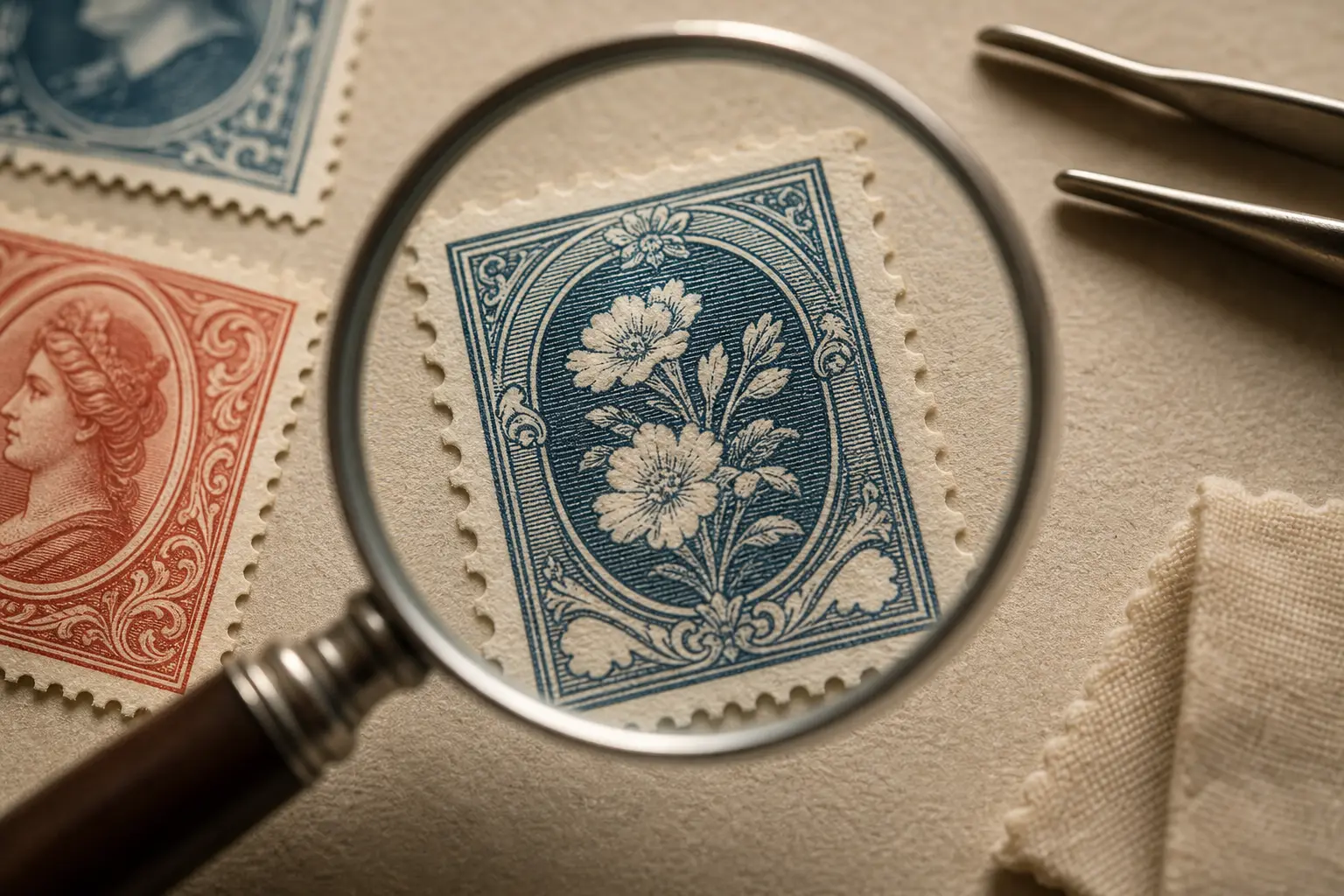
Begin with a clean, stable workspace and use non-contact magnification only. Check the whole stamp under diffuse light, then tilt it under oblique light to look for raised ink, debossing, or line structure. Next, inspect the image construction: are you seeing engraved lines, screened cells, or very fine dot layers? Keep in mind that each clue can point in the right direction without settling the question on its own.
After the visual check, compare your notes with a reliable reference and, when available, with production records. This is the safest way to separate line-engraved intaglio from gravure, letterpress, and lithography without damaging the stamp. If you are building a record for later review, note what you saw rather than what you hope it is. A careful description is more useful than a confident but unsupported identification.
When to stop and ask for more evidence
Stop when the clues conflict, when the stamp is unusually important, or when the item appears to be part of a mixed-process modern printing. The APS explicitly notes that more than one process may appear on a modern stamp, so mixed evidence is not unusual. In those cases, the most responsible move is to leave the identification provisional until you can compare it with stronger documentation.
This is also the point where condition and handling matter. Do not use household solvents, do not try to lift or disturb parts of the paper, and do not make repeated contact just to chase a better look. If you want to keep the item organised for later review, a note, scan, or collection record can help you return to it with better references. StampSnap can be used for that kind of provisional record, but not as a substitute for expert verification.
Frequently asked questions
Can I identify a stamp’s printing family from dots alone?
No. Dot patterns can be a clue for lithography or gravure, but they are not decisive on their own and must be weighed with other visual and production evidence.
What is the safest first clue to look for?
Start with the design structure under non-contact magnification and oblique light. Look for line-engraved intaglio lines, gravure screen cells, or lithographic dot layers, then compare all clues together.
Can modern stamps use more than one printing process?
Yes. The American Philatelic Society notes that more than one process may appear on a modern stamp, so mixed clues should be expected on some issues.
Should I rely on blurred edges to identify lithography?
No. The Smithsonian National Postal Museum says modern lithography can be sharp, so soft or blurred edges are not a dependable identifying rule.
How should I record an uncertain identification?
Record it as provisional and list the clues you observed. That keeps the note useful for later comparison with references or production records.