The fastest answer: look for the Great Britain exception
If a postage stamp does not show a country name, the first identification step is to check whether it may be from Great Britain. According to the American Philatelic Society, Great Britain is the only country permitted to issue postage stamps without including its name. In place of the country name, it may simply show the ruling monarch, often in the upper right corner.
That rule gives you a safe starting point, but it does not make every nameless stamp British. Many countries do not use English, so the country name may be present in another language or script that is not immediately familiar. Begin with the assumption that the missing name is a clue, not a conclusion, and verify it with other details.
Check the portrait, wording, and overall design first
When a stamp lacks a country name, the design itself becomes more important. A monarch portrait can be a strong clue because the APS notes that Great Britain may use an image of the ruling monarch rather than the country name. Look carefully at the portrait position, lettering style, and whether the issue appears to fit a traditional British format.
Do not rely on a single visual feature. A portrait alone cannot prove origin, and a stamp may share a broadly similar layout with other issues. Treat the design as a starting point for comparison, then move on to catalog references and physical characteristics that can be checked without harm.
Use a catalog as your main comparison tool
A stamp catalog is one of the most useful references for this problem because it gives illustrations and issue information side by side. The APS says catalogs can help identify stamps by showing the date issued, a description of the stamp, why it was issued, how it was printed, and the value in used and unused condition. That makes catalogs especially helpful when the country name is missing or hard to read.
Compare your stamp against catalog images before making any guess. Match the portrait, denomination style, printing notes, and visible layout, but remember that catalog images may not settle every case. If the stamp remains uncertain, record it as a likely match rather than a confirmed identification. StampSnap can be used to keep a likely identification and collection record, but it should not be treated as an official determination.
Look for perforation and watermark clues without damaging the stamp
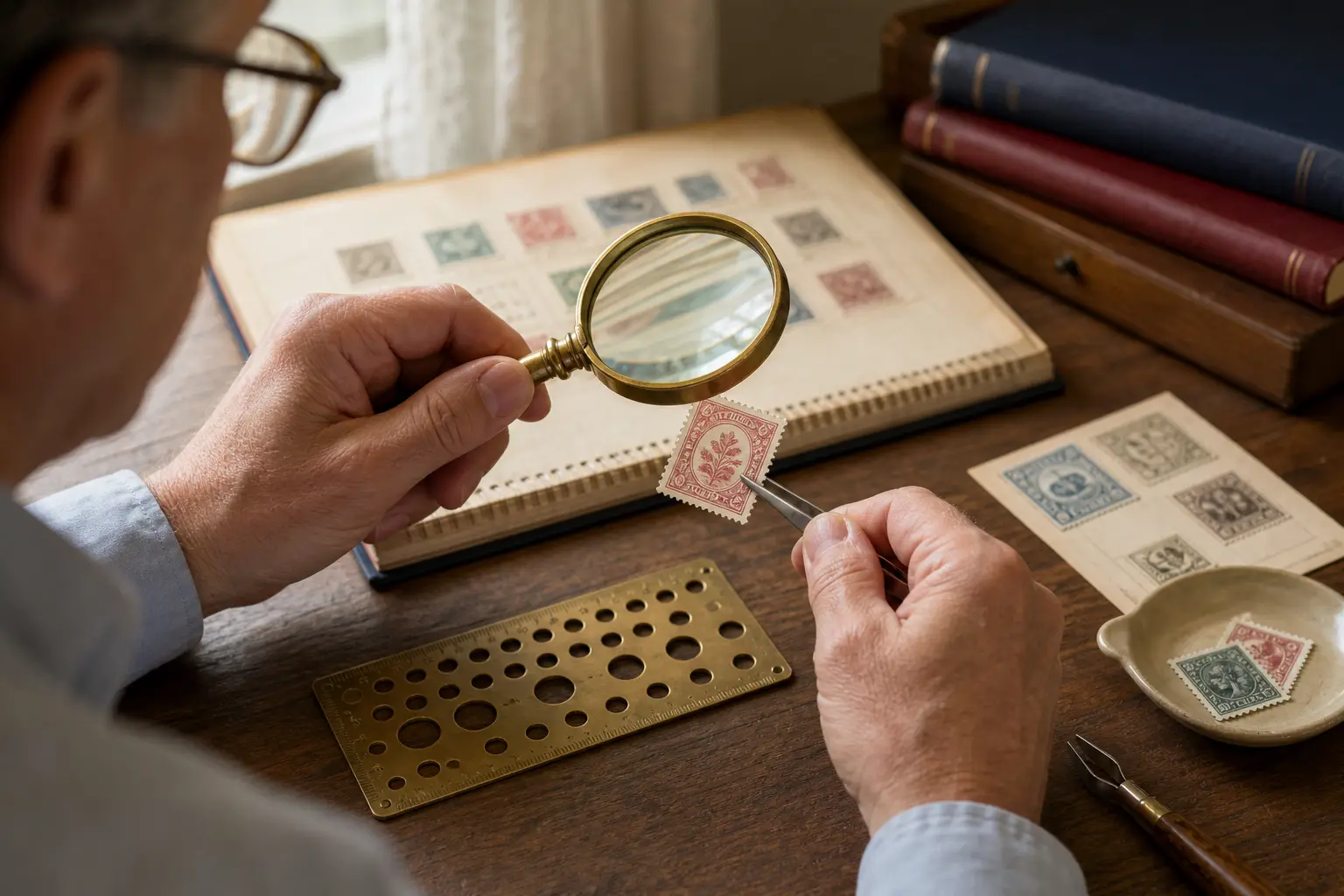
Some stamps look similar until you check perforations or watermarks. The APS explains that perforation gauges help measure the holes between stamps, because some issues share a design but differ in perforation counts. A gauge lets you compare the stamp against standard scales instead of trying to count every hole by eye.
Watermarks are another clue, but they should be examined gently and with the right tools. The APS includes a watermark detector among the basic identification aids for collectors. Use it as directed and avoid any method that could damage the paper. If you cannot confirm the watermark safely, leave the stamp as unidentified until you can inspect it properly.
Handle the stamp carefully while you identify it
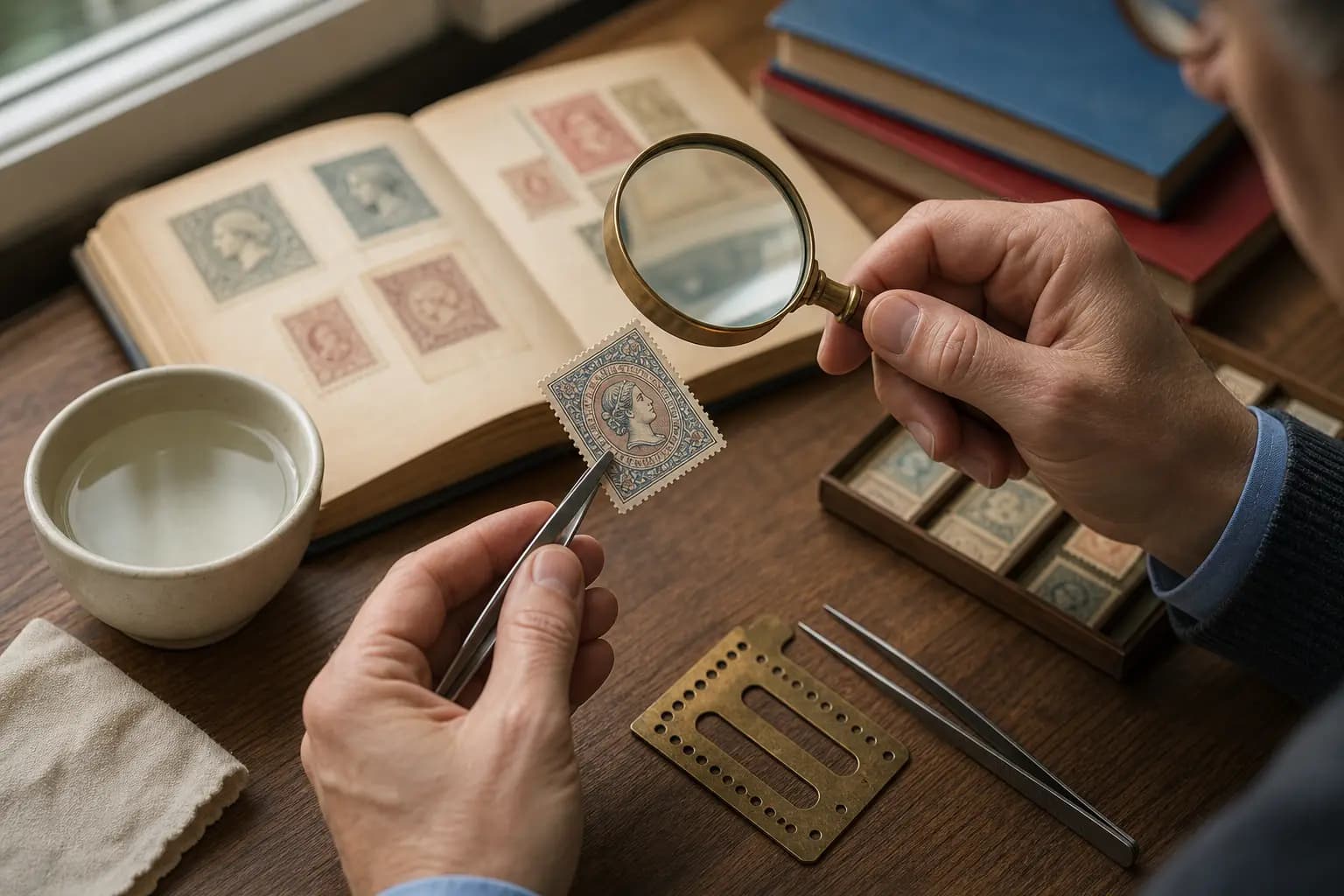
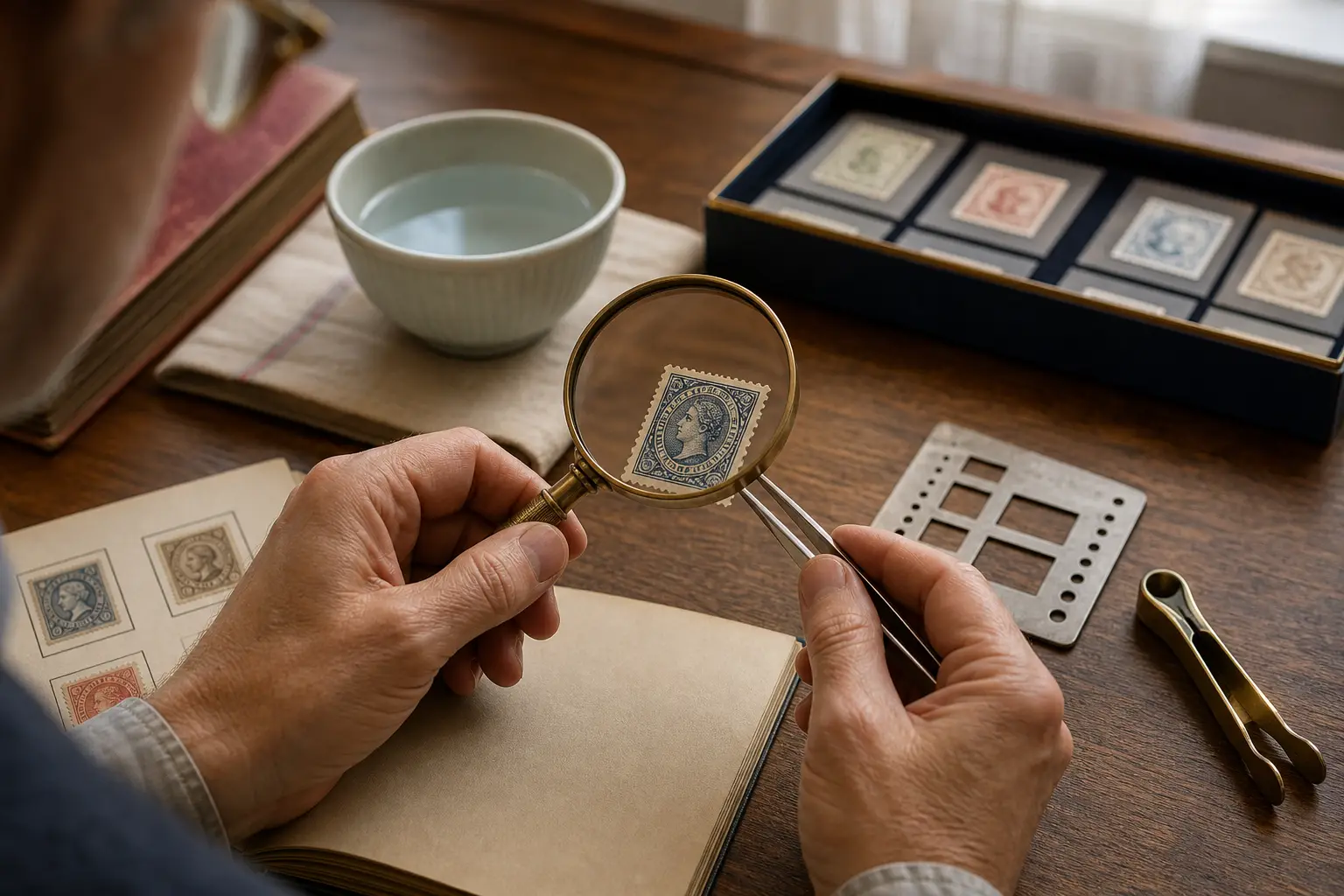
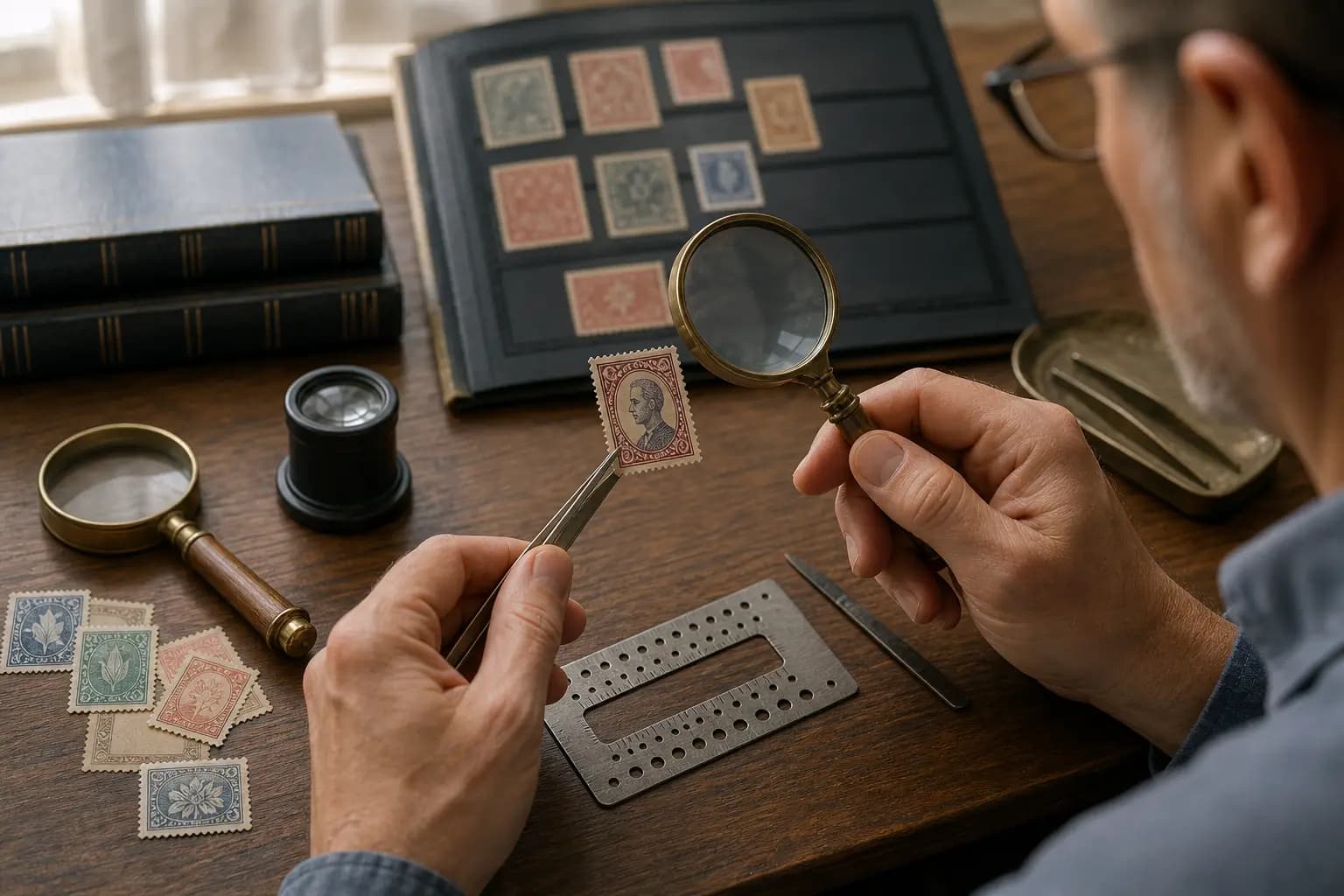
Good identification starts with good handling. The APS recommends stamp tongs for dry stamps because skin oil can damage them, even if your hands are clean. Tongs are designed with a smooth gripping surface so the stamp can be moved with less risk of bending or surface wear.
A magnifying glass also helps because small differences can separate similar issues. The APS recommends a lens that magnifies clearly without distortion, ideally around 5 to 10 times, and suggests choosing one that folds into a case to protect the lens. Use magnification to study the design, lettering, perforations, and any watermark-related details without pressing on the stamp.
Do not assume every old-looking stamp should be soaked or separated
Identification often leads to the question of whether a stamp should be removed from paper. For self-adhesive stamps, the APS says many United States examples issued before 2007 could often be removed by soaking in water, but most current U.S. self-adhesives use an oil-based backing and do not simply soak off. That means the removal method depends on the specific stamp, and guessing can cause damage.
If you are unsure what you have, keep the stamp in its current state until it is identified. Do not use tape, glue, or household solvents as a shortcut. The safest method is to identify first, then decide whether the item should stay as is, be stored on cover, or be handled with an appropriate collecting tool and a confirmed workflow.
Build a repeatable identification routine
A methodical routine helps prevent errors. Start with a visual check for any readable country name, then test the Great Britain exception, then compare the design with catalog illustrations, and only after that move to perforation and watermark checks. This order keeps you from over-interpreting a single clue too early.
Write down what you observe as you go: portrait, lettering, denomination, perforation pattern, and any watermark note. That creates a useful reference for future comparisons and makes it easier to revisit uncertain stamps later. A careful record is especially helpful when you are sorting mixed material or building a collection around a country, issue type, or monarch portrait.
When to stop and call it uncertain
If the stamp still does not match a clear catalog example, it is better to stop than to force an answer. Some stamps are straightforward, but others need better references or closer comparison. Uncertainty is normal in stamp identification, especially when the country name is missing, the print is worn, or the stamp is a close look-alike.
In those cases, save the observation, keep the stamp safe, and return to it later with a better light source, a cleaner magnifier view, or a more complete catalog. The goal is not to label every stamp immediately. The goal is to identify it accurately without reducing its condition or creating a false match.
Frequently asked questions
What is the first clue for identifying a stamp without a country name?
Check whether it may be from Great Britain, because the APS says Great Britain is the only country permitted to issue postage stamps without including its name.
Can a portrait alone identify an unnamed stamp?
No. A monarch portrait is a useful clue, but it should be confirmed with catalog images, perforation details, and other visible features.
What tools are most useful for this kind of identification?
The APS recommends a magnifying glass, stamp tongs, a stamp catalog, a perforation gauge, and a watermark detector for safer and more accurate identification.
Should I soak an unknown stamp before identifying it?
No. Identify the stamp first. The APS notes that self-adhesive stamps vary, and many current U.S. examples do not simply soak off because their backing is oil based.
What should I do if I cannot confirm the stamp safely?
Leave it as uncertain, record what you can observe, and revisit it later with better references or tools rather than risking damage.